
Game shows have been captivating audiences for over a century — and their story is wilder than most people realize. According to The Strong National Museum of Play, the genre traces all the way back to 1923 when The Brooklyn Daily Eagle launched a radio quiz called Brooklyn Eagle Quiz on Current Events. What started as a simple newspaper promotion became an entirely new form of entertainment.
The Early Days (1920s–1940s)
Early shows were modest affairs. Programs like Professor Quiz and Ask-It Basket gave the highest-scoring audience member a grand total of $25. But producer Ralph Edwards changed the game with Truth or Consequences in the late 1930s — and when commercial television launched on July 1, 1941, a special broadcast of that show was part of the very first programming lineup.
After World War II, the stakes shot up. Shows like Break the Bank, Stop the Music, and Hit the Jackpot offered life-changing prizes. Mark Goodson and Bill Todman — names that would become legendary — created Winner Take All, introducing concepts we still see today: returning champions and buzzing in.
The Scandal That Almost Killed Everything
In 1954, the Supreme Court ruled that game shows were not illegal lotteries, clearing the way for CBS to launch The $64,000 Question. Big-money quiz shows flooded the airwaves — but there was a problem. They were rigged. Contestants were being coached, answers predetermined. When former contestants came forward with proof, the entire genre collapsed. Laws were enacted, careers were destroyed, and game shows went into survival mode.
The 1970s Renaissance
The genre bounced back spectacularly. During 1972-73, CBS gave game shows a complete makeover with larger sets, vivid colors, and funky soundtracks. This era introduced The New Price Is Right with Bob Barker, Match Game '73 with Gene Rayburn, and The $10,000 Pyramid with Dick Clark. At one point in the 1970s, the three major networks had 19 game shows on the air simultaneously.
This decade also gave us two shows that would become syndication powerhouses: Wheel of Fortune (originally with Chuck Woolery) and Family Feud (with the inimitable Richard Dawson). It was also a time of firsts — Adam Wade became television's first Black game show host on Musical Chairs, and Betty White won the first Outstanding Game Show Host Emmy awarded to a woman for Just Men!
Syndication, Cable, and the Modern Era
In 1983, Wheel of Fortune with Pat Sajak and Vanna White became the biggest hit in syndication history. The following season, Jeopardy! with Alex Trebek was paired with it, creating an evening block that millions of households still watch nightly. Cable opened new doors: MTV gave us Remote Control, Nickelodeon delivered Double Dare and Legends of the Hidden Temple, and PBS had Where in the World Is Carmen Sandiego?
By 1994, network game shows had all but vanished except for The Price Is Right. Game Show Network launched that year to keep the flame alive. Then, as the millennium approached, Who Wants to Be a Millionaire? roared onto ABC and proved the genre still had massive mainstream appeal.
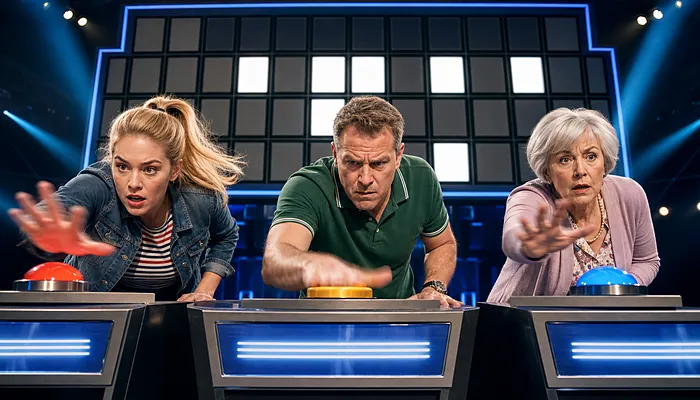
Today, prime-time reboots of Press Your Luck, The $100,000 Pyramid, Match Game, and others are thriving. A-list celebrities now host game shows. And Buzzr delivers vintage reruns around the clock for fans who can't get enough of the classics.
After more than a hundred years, game shows aren't just surviving — they're thriving.
The Hosts Who Built the Genre
Modern game shows are hosted by celebrities — comedians, actors, and media personalities who bring built-in audiences. But the genre was built by a different kind of talent: hosts who were game show professionals first, pioneers who defined what it meant to stand at the podium.
Bill Cullen: The Record-Setter
Bill Cullen's career in game shows is almost unmatched. According to The Strong National Museum of Play, Cullen launched his hosting career on Winner Take All — the show created by Mark Goodson and Bill Todman that introduced the concepts of returning champions and buzzing in. From there, Cullen went on to host a record-setting number of game shows across several decades, including The Price Is Right (the original 1956 version), I've Got a Secret, To Tell the Truth, and many more.
What made Cullen remarkable wasn't just longevity — it was his ability to make contestants comfortable and keep the show moving. He was the consummate game show professional at a time when the job description was still being written.
Adam Wade: Breaking the Color Barrier
In the 1970s, game shows were experiencing a golden age — but hosting remained almost exclusively white. Adam Wade changed that when he became television's first Black game show host on Musical Chairs. While the show itself had a short run, Wade's presence behind the podium was a milestone that paved the way for future hosts of color.
Betty White: The Emmy Trailblazer
Betty White is beloved for The Golden Girls and her legendary comedy career, but game show fans know she also made history in the genre. White hosted Just Men! in 1983 and won the first-ever Outstanding Game Show Host Emmy awarded to a woman. In an era when female game show hosts were virtually nonexistent, White proved that the role wasn't defined by gender.
Dennis James: The First of the First
Before all of them came Dennis James, who hosted Cash and Carry — recognized as the first regularly scheduled network game show when it debuted in 1946. James would go on to host The Price Is Right (the nighttime syndicated version), Name That Tune, and numerous other shows across a career spanning decades.
Their Legacy
These pioneers didn't just host shows — they helped establish game shows as a legitimate, respected television format. The hosting techniques they developed, the barriers they broke, and the audiences they built created the foundation that today's shows still stand on. Next time you watch Jeopardy! or Wheel of Fortune, remember: someone had to go first.
Sources: Museum of Play: A Brief History of Game Shows · National Archives of Game Show History
This article draws on research published by The Strong National Museum of Play's National Archives of Game Show History.

💬 Join the Discussion